Dholera: Understanding the City, SIR and the Investment Opportunity
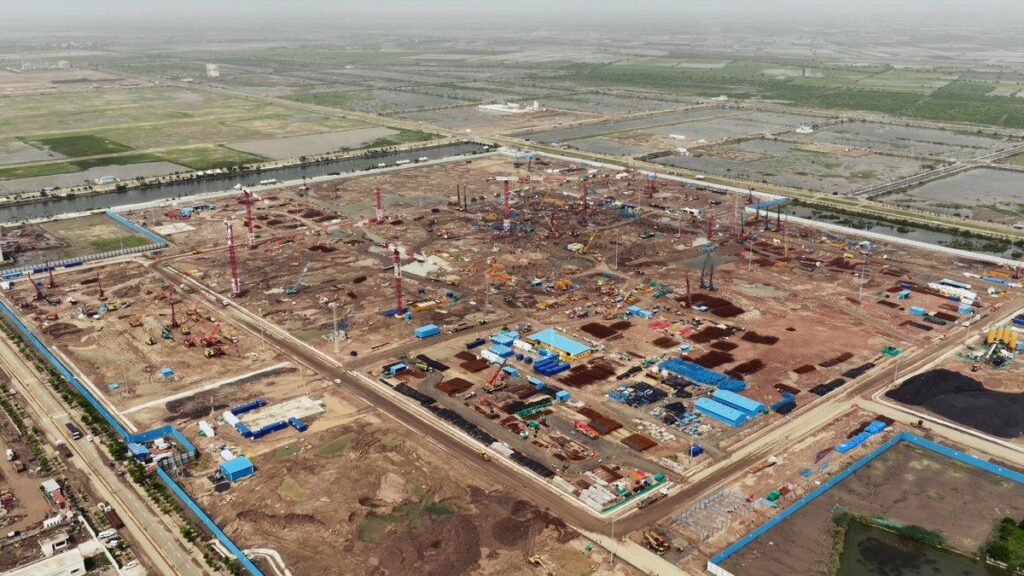
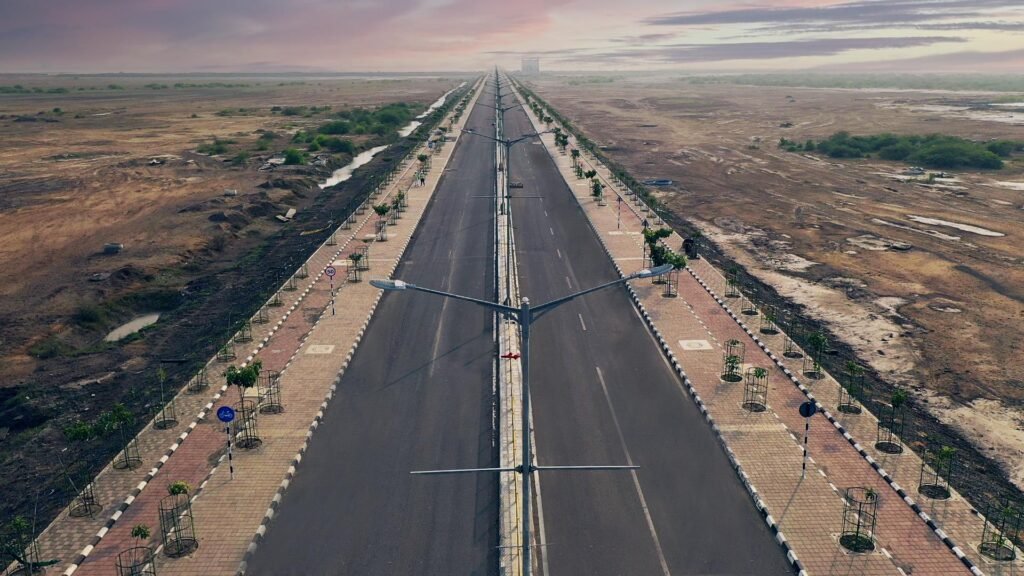
Dholera is no longer just a future-city concept. But that does not mean every property marketed in its name is automatically a good investment.
Dholera has emerged as one of India’s most closely watched greenfield industrial-development regions. The combination of the Dholera Special Investment Region (DSIR), semiconductor manufacturing, major road and rail infrastructure, an international airport and planned industrial expansion has created a compelling long-term development story.
For investors, however, the opportunity needs to be understood carefully.
The right question is not simply “Will Dholera grow?” The more important question is:
“Which parts of Dholera are actually developing, what economic activity will drive that development, and does the property I am considering have a genuine connection to that growth?”
This article explains the Dholera story from an investor’s perspective and highlights what should be verified before investing.
Dholera Is More Than a Real-Estate Market
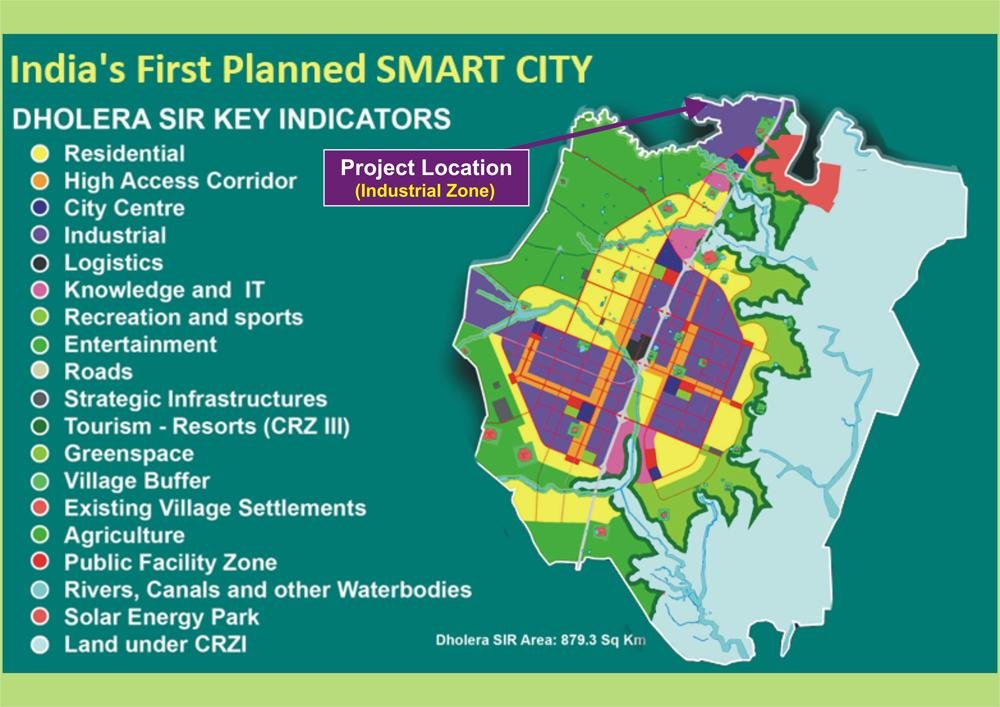
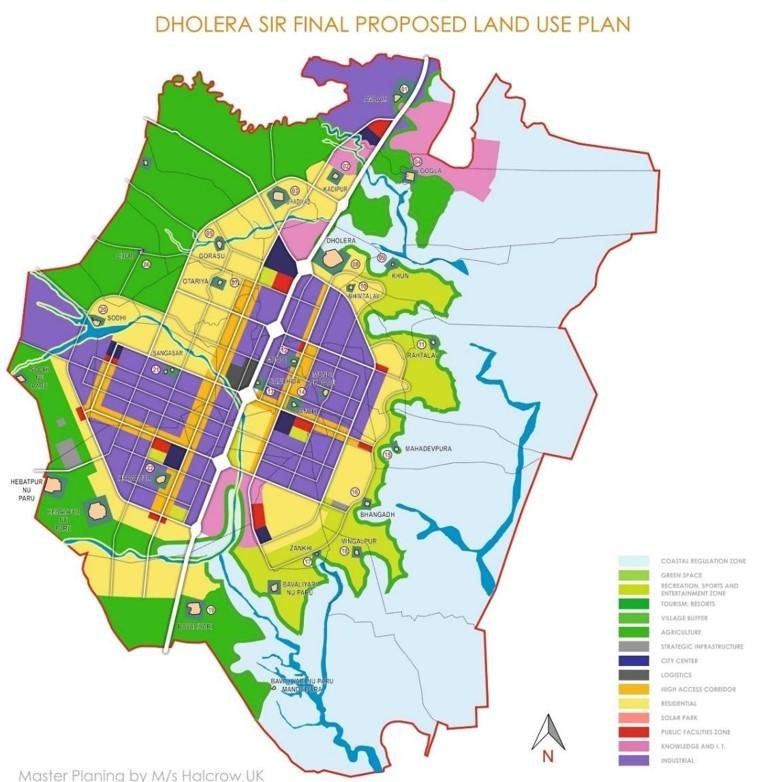
Dholera Special Investment Region is a planned greenfield industrial city in Gujarat and a major node of the Delhi–Mumbai Industrial Corridor.
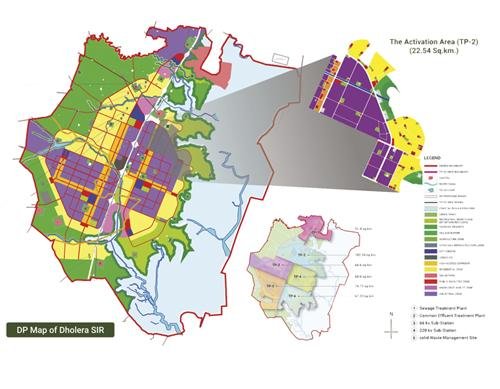
According to the National Industrial Corridor Development Corporation (NICDC), Dholera SIR covers approximately 920 sq km, while its 22.54 sq km Activation Area forms the initial development zone where trunk infrastructure has been developed. (NICDC)
This distinction is extremely important.
920 sq km is the broader development area.
It should not be interpreted as 920 sq km of already-developed urban land.
The Activation Area is considerably more relevant when evaluating near-term development.
Dholera’s planned economic sectors include:
- Semiconductors
- Aerospace and defence
- Solar-component manufacturing
- Green hydrogen
- Pharmaceuticals and biotechnology
- Heavy engineering
(NICDC)
The underlying objective is therefore to create an industrial and economic ecosystem first, with urban development growing around it.
Why Dholera Has Attracted Investor Attention
The Dholera investment story has become stronger because several major developments are converging.
The most important are:
Semiconductor manufacturing
Ahmedabad–Dholera Expressway
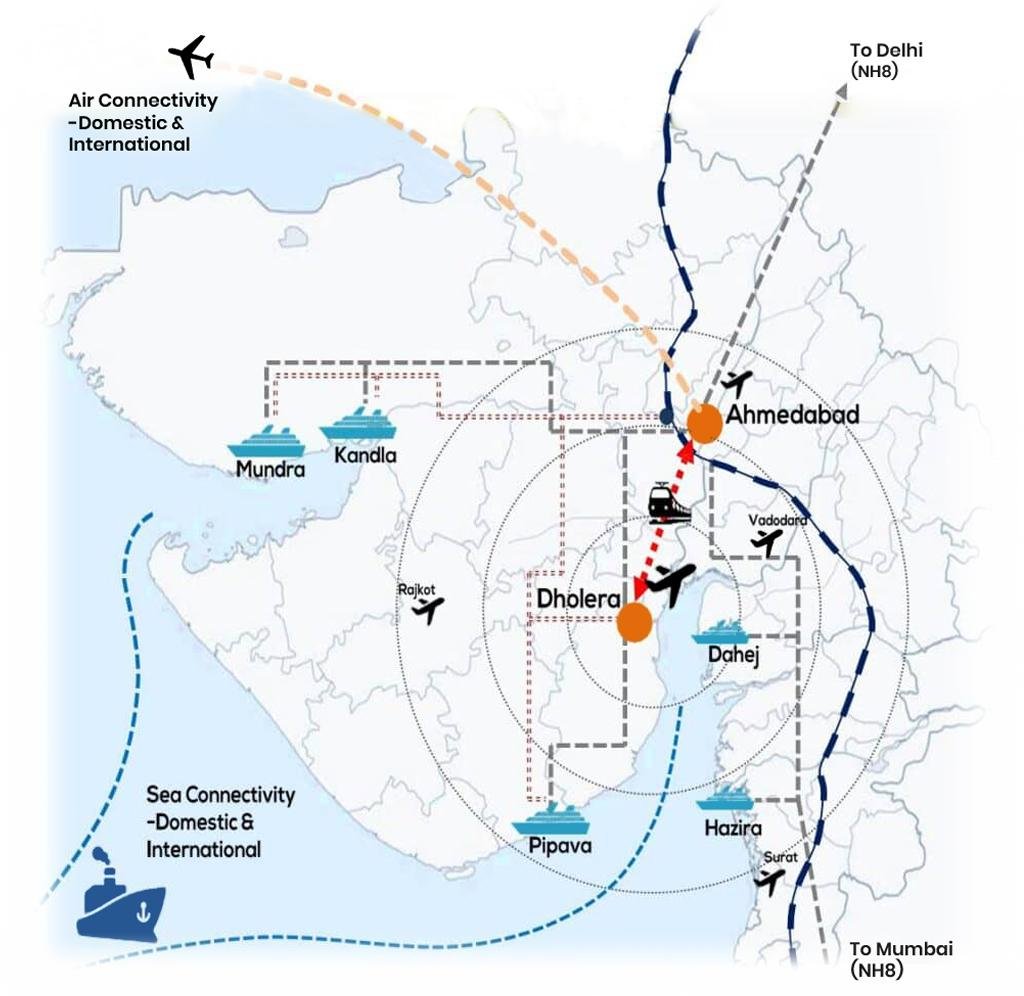
Dholera International Airport
Ahmedabad–Dholera railway
Industrial and logistics infrastructure
Supporting residential and commercial development
Together, these developments have the potential to transform Dholera from a planned industrial region into a significant economic centre.
But potential is not the same as certainty.
Investors should therefore evaluate each catalyst according to its actual stage of execution.
The Semiconductor Project: The Biggest Industrial Catalyst
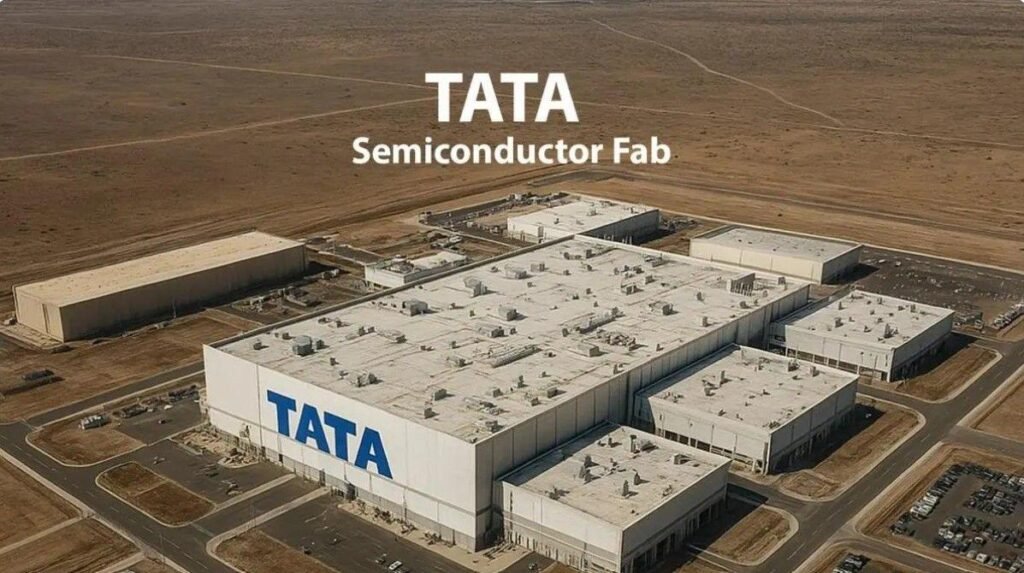
Perhaps the most significant development in the Dholera story is Tata’s semiconductor fabrication project.
In April 2026, the Government of India notified the Special Economic Zone for Tata Semiconductor Manufacturing Private Limited at Dholera.
The notified SEZ covers approximately 66.166 hectares and is expected to provide employment to approximately 21,000 people. The project has a proposed investment of ₹91,000 crore. (Press Information Bureau)
Government information regarding the semiconductor fab has also described a planned capacity of 50,000 wafer starts per month and more than 20,000 direct and indirect skilled jobs. (Press Information Bureau)
For investors, the significance is much greater than the headline investment amount.
A semiconductor facility can generate an ecosystem of:
- Equipment suppliers
- Electronics manufacturers
- Engineering companies
- Construction and maintenance companies
- Logistics providers
- Materials and chemical suppliers
- Professional services
- Hospitality
- Healthcare
- Education
- Employee housing
- Retail and commercial services
This is how industrial investment can eventually translate into real-estate demand.
The Development Chain Investors Should Watch
A sustainable real-estate market generally develops through a chain:
Industrial investment
↓
Factories and businesses
↓
Employment
↓
Population and migration
↓
Housing demand
↓
Retail and services
↓
Schools and healthcare
↓
Commercial activity
↓
Property transactions
↓
Price discovery
This is a much more useful framework than simply assuming that a large infrastructure announcement will automatically increase property prices.
Ahmedabad–Dholera Expressway
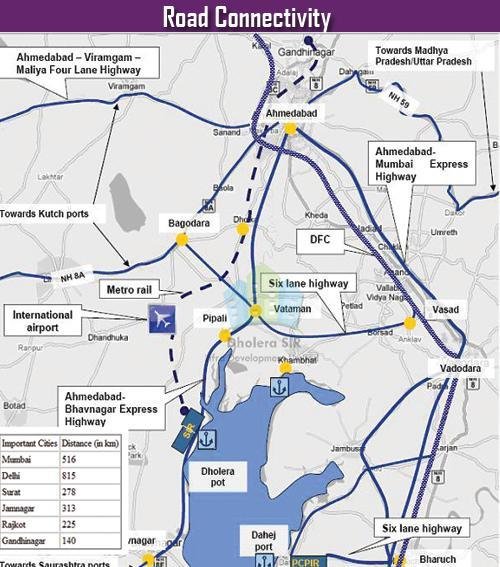
Connectivity is another important component of the Dholera development story.
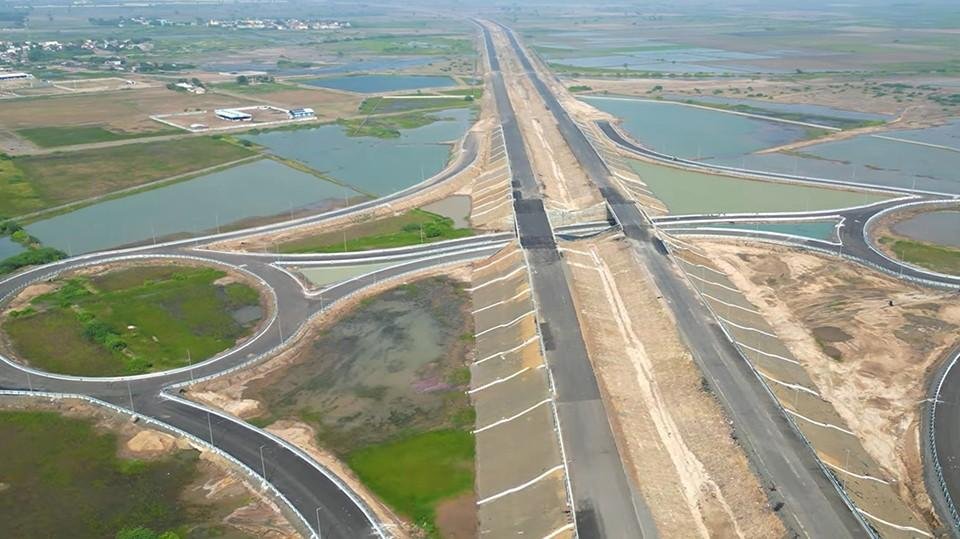
The Ahmedabad–Dholera Greenfield Expressway is approximately 109.019 km long and was developed at a reported project cost of around ₹5,800 crore. The Ministry of Road Transport & Highways describes the expressway as providing connectivity to Dholera SIR and the surrounding region. (Press Information Bureau)
Improved road connectivity can reduce travel friction between Ahmedabad and Dholera and support:
- Industrial logistics
- Employee movement
- Supplier networks
- Business travel
- Regional commerce
But investors should make an important distinction:
Better connectivity can support property demand, but connectivity alone does not establish the value of a particular plot.
The exact location of the property still matters.
Dholera International Airport
The airport is another major component of the long-term development plan.
The Ministry of Civil Aviation reviewed the progress of Dholera International Airport in July 2026 and described it as an important component of Dholera’s multimodal connectivity strategy. The planned passenger terminal is designed for approximately 2 million passengers annually. (Press Information Bureau)
The airport’s significance extends beyond passengers.
It could support:
- Industrial executives
- Business travel
- High-value manufacturing
- Logistics
- Aerospace activity
- International business connectivity
However, investors should avoid one common mistake:
Do not value a property simply because it is “near the airport.”
There is a substantial difference between:
airport announced
airport under construction
airport operational
and
airport generating significant passenger and business traffic.
The property’s actual access to the airport also matters.
Ahmedabad–Dholera Railway
In May 2026, the Union Cabinet approved the Ahmedabad (Sarkhej)–Dholera Semi High-Speed Double Line project.
The project has an estimated cost of approximately ₹20,667 crore, covers about 134 km, and is targeted for completion by 2030–31. It is planned to connect Ahmedabad, Dholera SIR, the upcoming Dholera Airport and Lothal. (Press Information Bureau)
For Dholera, this could eventually be important for daily commuting and regional connectivity.
For investors, however, the appropriate approach is:
Treat sanctioned infrastructure as a future catalyst, not as an already-operational benefit.
Dholera SIR vs. “Dholera Property”
This is perhaps the most important section for a property investor.
A property can be marketed using the word:
Dholera
without necessarily having the same characteristics as property located within the core SIR development.
Before investing, establish:
- Exact village
- Survey number
- Whether the land is inside DSIR
- TP scheme
- Original Plot
- Final Plot
- Land-use classification
- NA status
- Approved layout
- Road access
- Authority approvals
- Distance from active infrastructure
Two properties can both be marketed as “Dholera plots” and yet have very different legal status, development prospects and liquidity.
Why TP and Final Plot Status Matter
Dholera is being developed through a planned town-planning framework.
This means investors should not evaluate land solely by looking at a private layout map.
The verification chain should be:
Survey Number → TP Scheme → Original Plot → Final Plot → Area → Land Use → Road → Reservations → Ownership
If a salesperson says:
“This is TP-approved land”
that statement should be supported by official documentation.
Similarly, if a property is advertised as being close to a particular infrastructure project, verify the location using the actual survey/plot details.
Don’t Buy the Dholera Story. Buy the Asset.
One of the biggest risks in an emerging property market is buying the story instead of the asset.
For example:
Tata is investing ₹91,000 crore in Dholera.
This is a documented industrial-development fact. (Press Information Bureau)
But:
“Therefore this particular plot will become ₹50,000 per sq yd.”
is a property-price prediction.
Those two statements are not equivalent.
Between them are several variables:
Industrial investment
→ employment
→ local economic activity
→ housing demand
→ actual property transactions
→ market-supported prices.
Investors should therefore avoid treating a large project announcement as a direct guarantee of property appreciation.
What Should Determine the Value of a Dholera Property?
A disciplined investor should evaluate at least eight factors.
1. Location
Where exactly is the property?
2. Legal status
Is the title clear and independently verified?
3. Land use
What can legally be developed?
4. TP/Final Plot status
What is the property’s position within the planning framework?
5. Infrastructure
What infrastructure exists today, and what is genuinely under execution?
6. Employment proximity
What economic activity could create demand around the property?
7. Entry price
How does the all-in cost compare with comparable evidence?
8. Exit liquidity
Who is likely to buy the property from the investor later?
The Importance of Employment
For residential and commercial real estate, employment is ultimately one of the most important demand drivers.
Dholera’s semiconductor project provides an important industrial anchor, but investors should watch what happens around it.
Look for evidence such as:
- New industrial units
- Supplier companies
- Employee numbers
- Housing occupancy
- Rental activity
- Hotels
- Schools
- Hospitals
- Restaurants
- Retail
- Warehousing
- Commercial offices
These indicators tell us whether an industrial project is translating into a broader urban economy.
The 20-Lakh Population Question
Dholera’s long-term planning vision has often been associated with a population of approximately 2 million and a large employment base.
Investors should be careful with such numbers.
A planning target is not today’s population.
Nor does a long-term population target tell us exactly when population growth will occur.
The more useful question is:
Is Dholera accumulating the jobs and infrastructure required to support that population?
Therefore, investors should monitor actual:
employment → migration → occupancy → consumption → transactions
rather than simply quoting the eventual population target.
Property Prices: Look Beyond Asking Prices
Another common mistake is to use a broker’s quoted price as evidence of market value.
Investors should distinguish between:
Asking price
Negotiated price
Registered transaction price
These are not necessarily the same.
Online property portals can be useful for understanding the range of asking prices, but they should not automatically be treated as evidence of actual transaction values.
For a serious investment, comparable transactions should be independently verified.
Build an Investment Model, Not a Price Prediction
Instead of saying:
“Dholera will give 20% CAGR.”
investors should use scenarios.
For example, if the total investment including acquisition costs is ₹22 lakh, a purely illustrative model might look like this:
| Scenario | Annual appreciation | Year 5 | Year 10 | Year 15 |
|---|---|---|---|---|
| Conservative | 6% | ₹29.4 lakh | ₹39.4 lakh | ₹52.7 lakh |
| Base scenario | 10% | ₹35.4 lakh | ₹57.0 lakh | ₹91.9 lakh |
| High-development scenario | 15% | ₹44.3 lakh | ₹88.9 lakh | ₹178.3 lakh |
These are mathematical scenarios, not forecasts.
The purpose is to demonstrate how sensitive the eventual outcome is to the assumed rate of appreciation.
What Could Go Wrong?
A responsible investor should also understand the downside.
Infrastructure delays
Large infrastructure projects can take longer than planned.
Industrial execution risk
An announced investment is different from an operating factory.
Slower population growth
Industrial development may precede mass residential demand by several years.
Liquidity risk
A property may have a high quoted value but a limited number of actual buyers.
Overpricing
Future development may already be incorporated into today’s asking price.
Legal risk
An attractive price cannot compensate for unclear title or problematic land status.
Land-use risk
Agricultural land should not automatically be treated as immediately developable residential land.
Peripheral-location risk
A property can be marketed as Dholera while being sufficiently distant from actual development to have a very different investment profile.
A Simple Dholera Investor Due-Diligence Test
Before paying a booking amount, an investor should be able to answer:
Property
What is the exact survey number?
Planning
Which TP scheme and Final Plot does it belong to?
Land use
What can legally be developed?
Ownership
Who owns it and is the title clear?
Infrastructure
What exists today?
Development
Which industrial projects are actually progressing nearby?
Pricing
What are comparable properties actually transacting at?
Exit
Who is likely to buy this property from me later?
If these questions cannot be answered clearly, the investor should pause before committing capital.
A Practical Dholera Investment Scorecard
Investors can assess a property using a simple 100-point framework:
| Factor | Weight |
|---|---|
| Location & development proximity | 20 |
| Legal/title clarity | 20 |
| TP/Final Plot/zoning | 15 |
| Infrastructure accessibility | 15 |
| Industrial/employment proximity | 10 |
| Price/value assessment | 10 |
| Liquidity/resale potential | 5 |
| Developer/project credibility | 5 |
| Total | 100 |
This score is not a prediction of returns.
Its purpose is to ensure that investors don’t make a decision based on one attractive feature—such as an airport, expressway or semiconductor project—while ignoring the rest of the investment equation.
The Dholera Investment Timeline
Dholera should be viewed as a long-duration development story.
Near term
The focus is likely to remain on:
- Industrial construction
- Semiconductor development
- Infrastructure
- Connectivity
- Initial employment
- Supporting services
Medium term
If industrial development progresses:
- Employee housing
- Rental housing
- Commercial activity
- Hotels
- Healthcare
- Education
- Retail
could become increasingly important.
Long term
If the planned industrial and urban development is substantially realised, Dholera could evolve into a much larger integrated economic and urban centre.
The timing, however, remains an important investment variable.
The Right Way to Think About Dholera
Dholera should not be evaluated simply as:
“A place where land prices may increase.”
It should be evaluated as:
“A developing industrial ecosystem where certain real-estate assets may benefit from increasing economic activity.”
That difference changes the entire investment approach.
Final Takeaway for Investors
Dholera deserves serious attention.
The region has a substantial planned development framework, a 920 sq km SIR, a 22.54 sq km Activation Area, major road connectivity, a planned airport, and a sanctioned ₹20,667 crore rail project. (NICDC)
Most importantly, Dholera now has a major semiconductor manufacturing anchor. The Government has notified Tata Semiconductor Manufacturing’s SEZ with a proposed investment of ₹91,000 crore and approximately 21,000 employment opportunities. (Press Information Bureau)
These developments make Dholera a region worth studying.
But they do not make every Dholera property a good investment.
For an investor, the correct sequence is:
Understand Dholera
→ Identify the development zone
→ Verify the property
→ Check legal and planning status
→ Assess infrastructure
→ Identify employment drivers
→ Validate the price
→ Model different outcomes
→ Assess liquidity
→ Then decide.
The investor’s objective should not be to predict Dholera’s future. It should be to identify assets that have a defensible connection to that future—and to avoid paying an excessive premium for expectations that have not yet materialised.
About Realinfra
Realinfra focuses on helping investors approach emerging real-estate opportunities through information, due diligence and investment awareness.
Our objective is simple:
Verify the asset. Understand the development. Evaluate the risk. Then invest with awareness.
This article is for investor education and awareness. It is not a guarantee of property appreciation, rental income, liquidity or future infrastructure completion. Investors should independently verify title, land use, approvals, planning status, transaction values, taxes and other applicable matters through qualified professionals before investing.
Comments are closed